
Free Gravel Calculator: Estimate Tons, Yards & Cost
Stop guessing. Start calculating. Get exact gravel estimates for your driveway, patio, or landscaping project in seconds.
Last Updated: 16 August 2026 at 12:00 PM
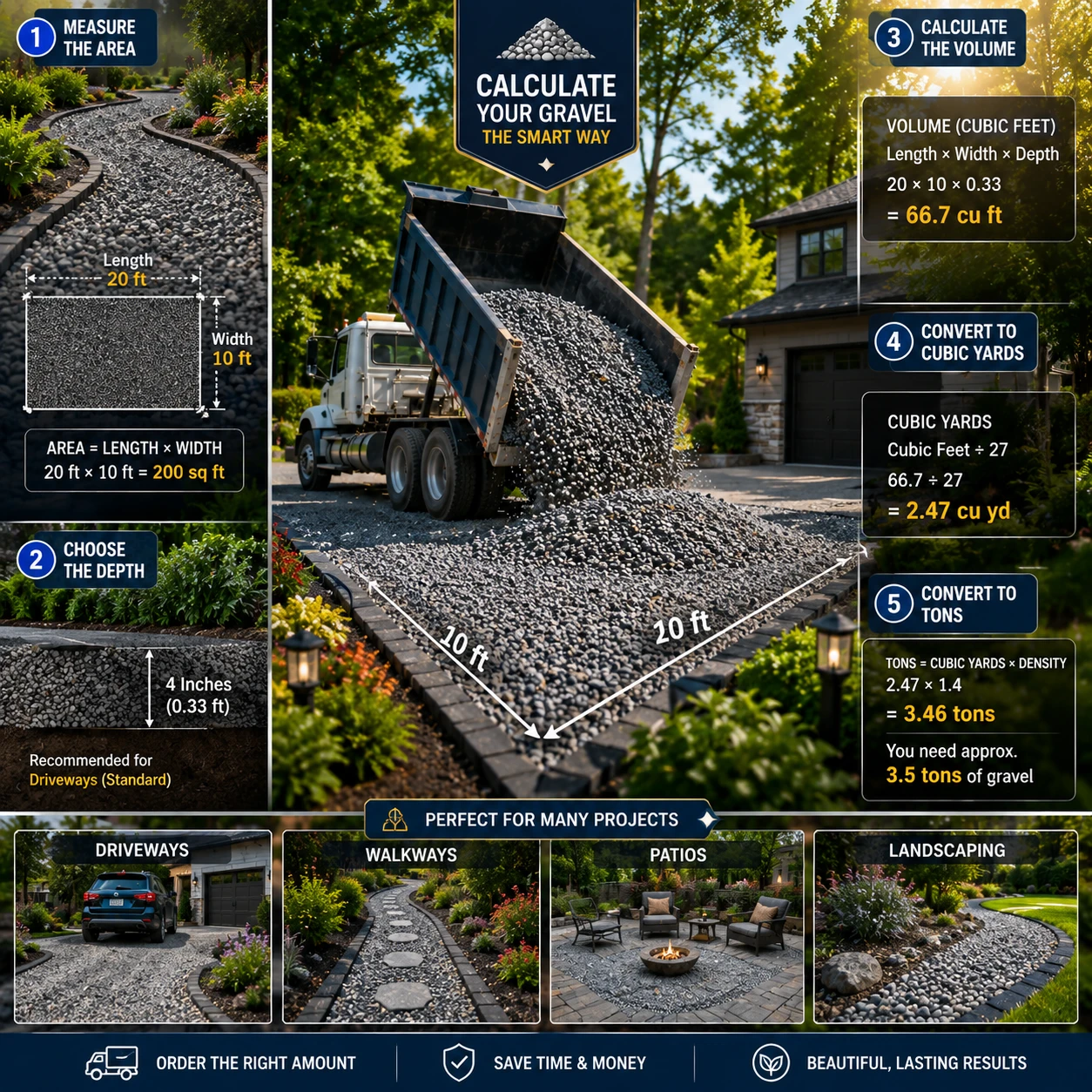
If you are planning a driveway, walkway, or landscaping project and don’t know exactly how much gravel you need. Now stop over-ordering or frustrating shortages.
This free gravel calculator and estimator can handle any project — from small patios to large driveways. You just have to enter dimensions, select gravel type, add waste factor, and get instant estimates in cubic yards, tons, and total cost. Whether you’re a homeowner or contractor, this gravel quantity calculator helps you to order the right amount of gravel every time.
gravel-calculator
Estimate the gravel you need for your driveway, patio, walkway, or landscaping project.
This gravel bag calculator shows exactly how many bags you need based on your project size.
How to Calculate Gravel with this Free Gravel Calculator – Step-by-Step Guide:
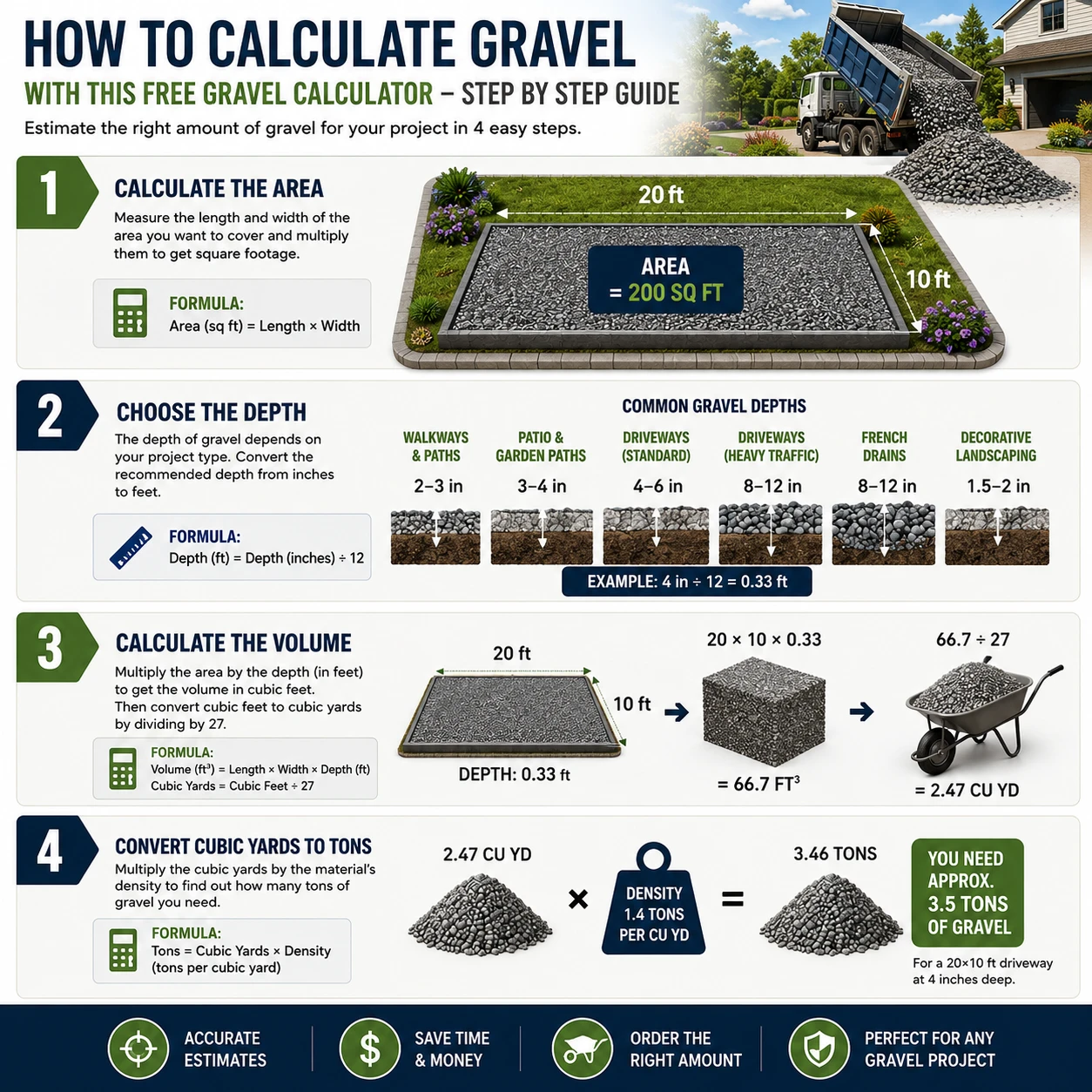
To estimate how much gravel you need, follow these four simple steps to get an accurate gravel calculation for your project using the gravel calculator.
Step 1: Measure the Area:
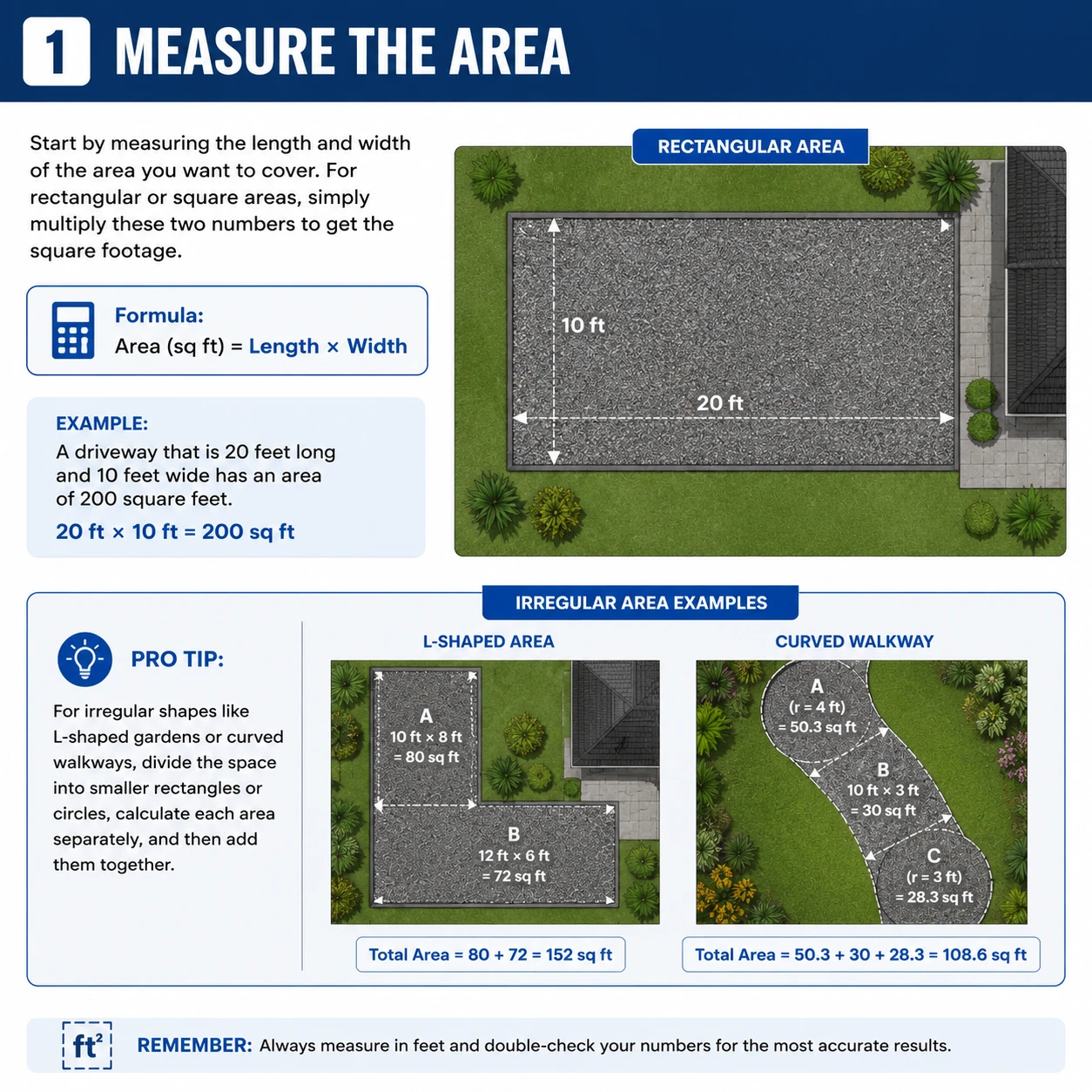
First, grab a tape measure and note your length and width. Enter them into the gravel calculator — that’s where it all starts. This landscape gravel calculator works for any shape or size of the area you want to cover with gravel. If you have rectangular or square areas, simply multiply these two numbers to get the square footage.
Formula: Area (sq ft) = Length × Width
Example: If a driveway is 20 feet long and 10 feet wide, then its area will be 200 square feet. Using a gravel calculator, you can see how much gravel volume is required to cover this area.
Pro Tip: If you have irregular shapes like L-shaped gardens or curved walkways, divide the space into smaller rectangles or circles, then calculate each area separately, and then add them together. The gravel calculator can handle any shape once you have your total area.
Step 2: Determine the Depth:
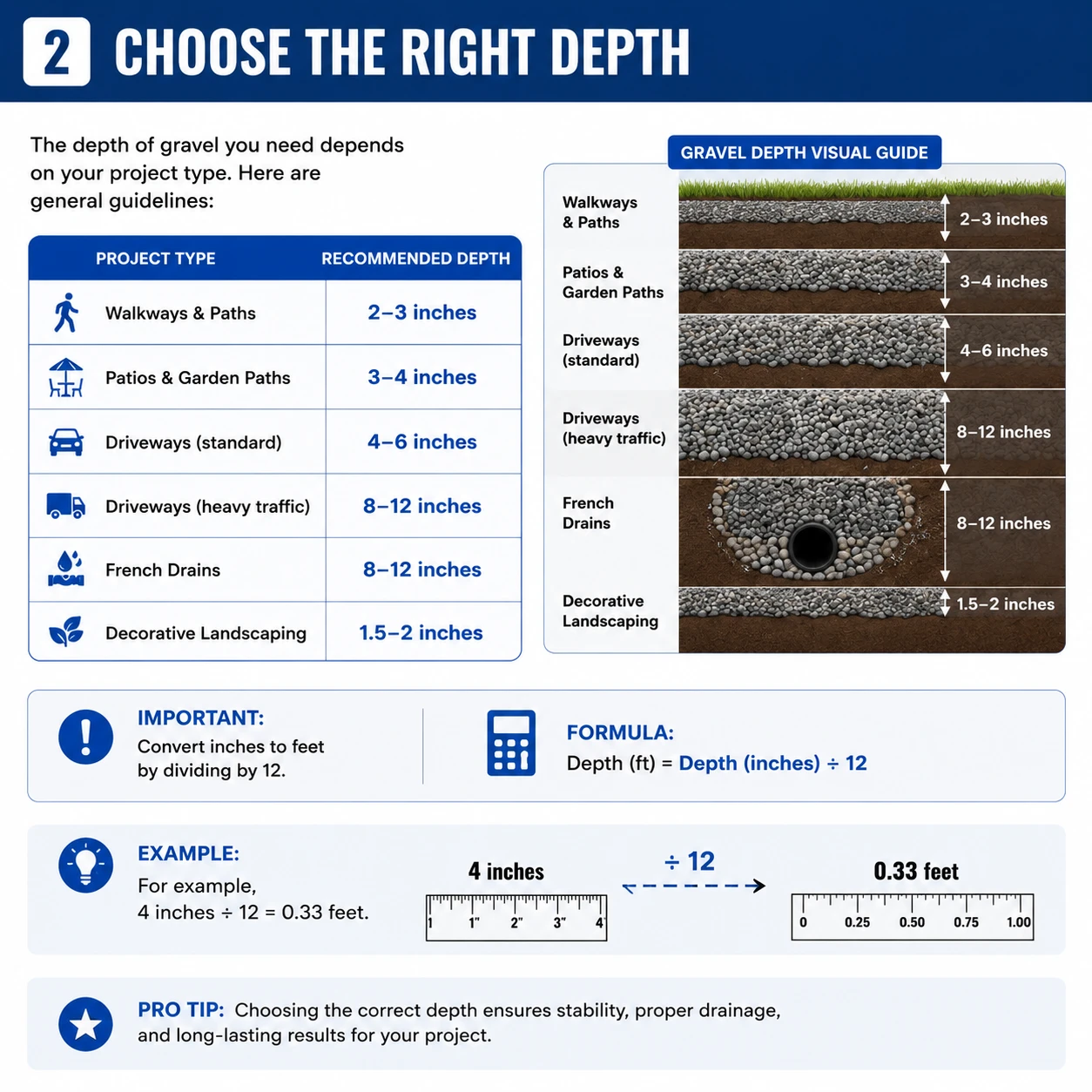
Now, how deep should you go? That depends on your project — a walkway needs less than a driveway.
By using a gravel calculator, you can see that a 20×10 ft driveway with 4 inches depth requires approximately 2.47 cubic yards of gravel before adding a waste factor. To determine your exact volume and weight requirements. Here are general guidelines to help you to choose the right depth:
| Project Type | Recommended Depth |
|---|---|
| Walkways & Paths | 2–3 inches |
| Patios & Garden Paths | 3–4 inches |
| Driveways (standard) | 4–6 inches |
| Driveways (heavy traffic) | 8–12 inches |
| French Drains | 8–12 inches |
| Decorative Landscaping | 1.5–2 inches |
Important: Convert inches to feet by dividing by 12.
Formula: Depth (ft) = Depth (inches) ÷ 12
For example, 4 inches ÷ 12 = 0.33 feet.
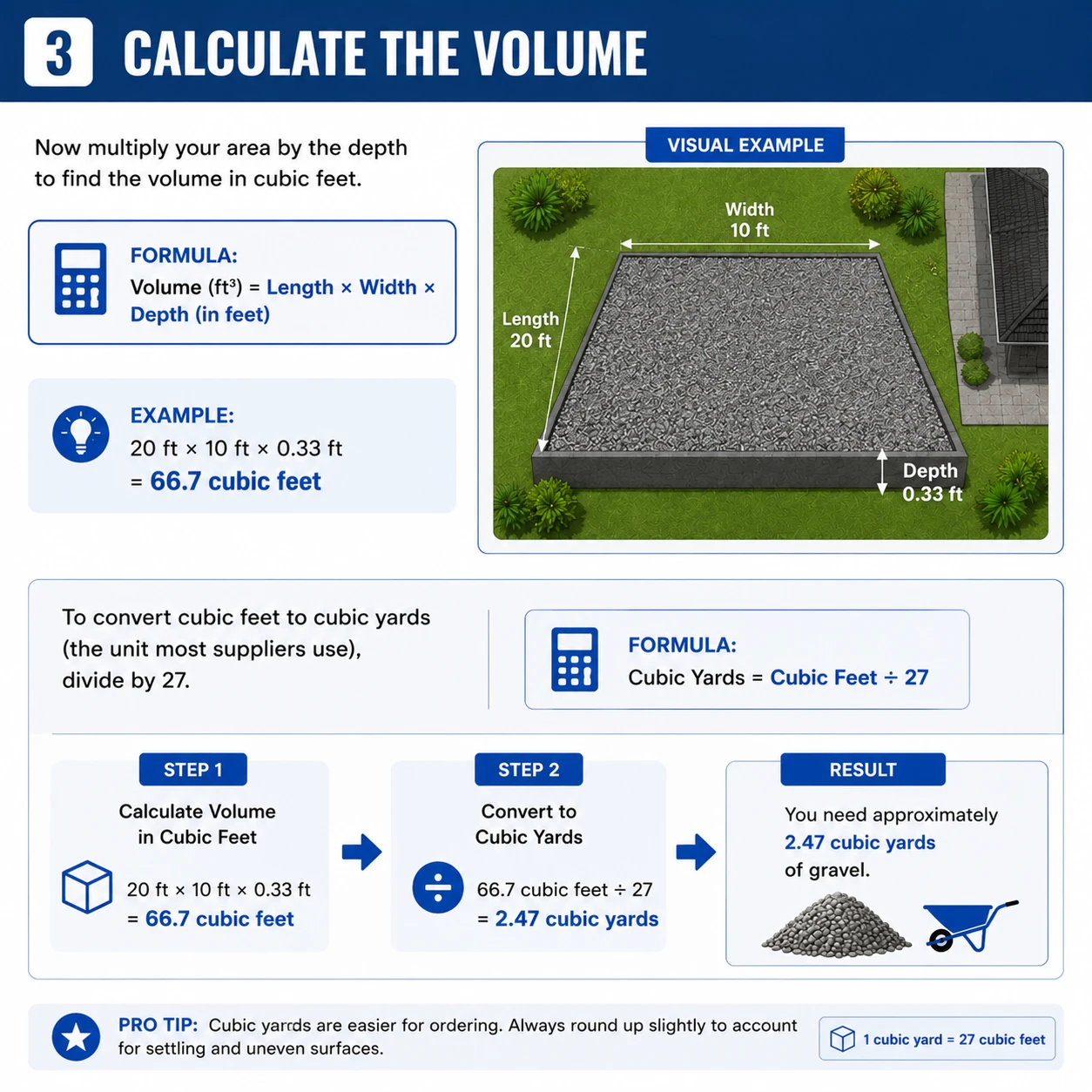
Step 3: Calculate the Volume:
This gravel volume calculator now multiplies your area by the depth to find the volume in cubic feet.
Formula: Volume (ft³) = Length × Width × Depth (in feet)
Example: 20 ft × 10 ft × 0.33 ft = 66.7 cubic feet
To convert cubic feet to **cubic yards** (a unit mostly gravel suppliers use), divide cubic feet by 27. A gravel estimator does this conversion instantly, so you don’t have to do the math manually.
Formula: Cubic Yards = Cubic Feet ÷ 27
Example: 66.7 ÷ 27 = 2.47 cubic yards.
By using a gravel coverage calculator, you can see that a 20×10 ft driveway with 4 inches depth requires approximately 2.47 cubic yards of gravel before adding a waste factor.
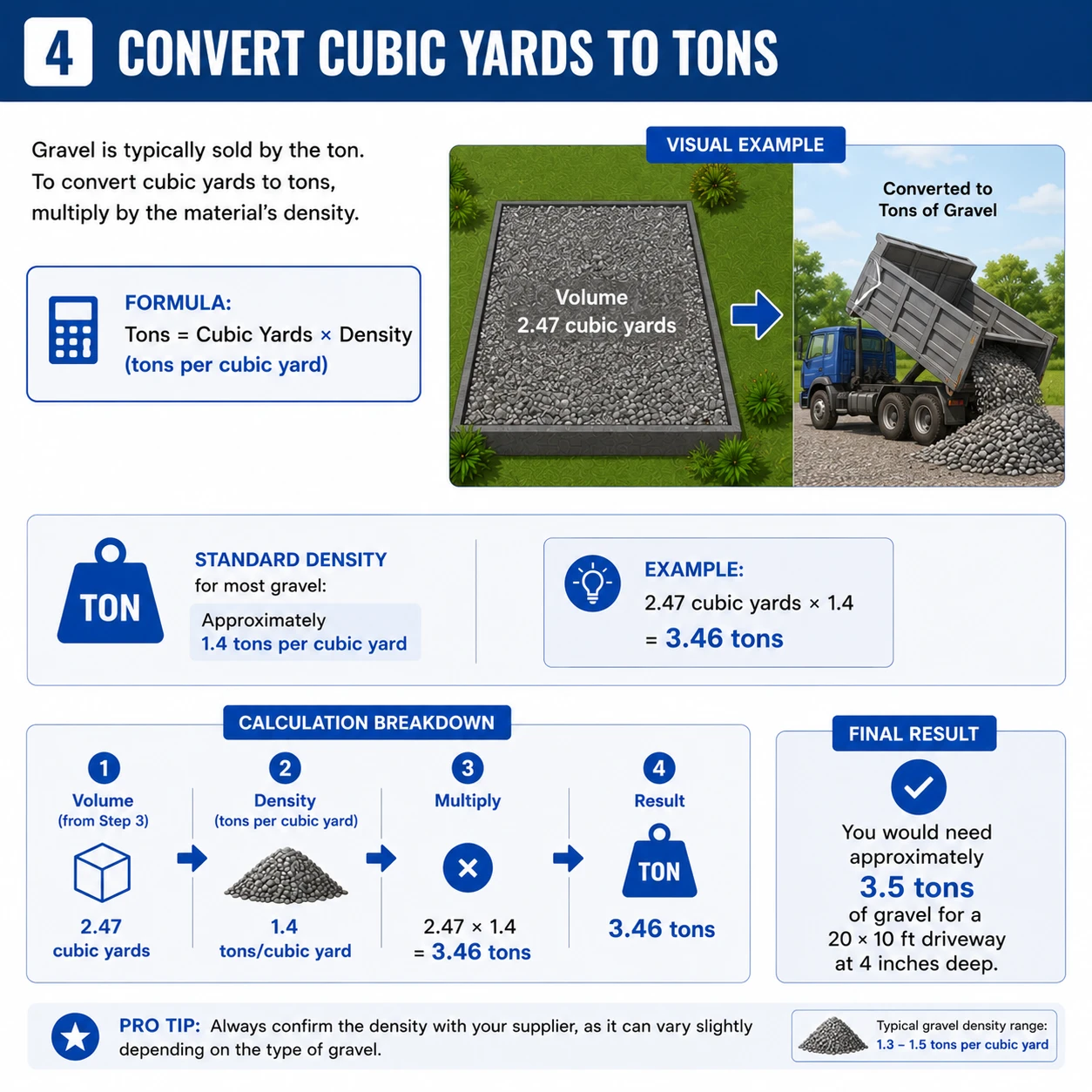
Step 4: Convert Volume to Weight:
Gravel is typically sold by the ton. A gravel weight calculator converts cubic yards to tons by multiplying by the material’s density. The gravel for driveway calculator gives you this final number instantly, so you know exactly what to order.
Formula: Tons = Cubic Yards × Density (tons per cubic yard)
Standard density for most gravel: Approximately 1.4 tons per cubic yard
Example: 2.47 cubic yards × 1.4 = 3.46 tons
Final Result: If you have a 20×10 ft driveway with 4 inches depth, you would need approximately **3.5 tons** of gravel. The gravel for the driveway calculator gives you this final number instantly. This gravel weight calculator also helps you convert volume to tons with precision, so you know exactly what to order.
Gravel Types and Coverage Guide:
Different gravel types have different densities, appearances, and best uses. A gravel estimator includes these options so you can get accurate results for your specific material.
Gravel Cost Estimates (Per Ton & Per Yard)
Understanding gravel costs helps you to budget accurately for your project. A gravel cost estimator gives you a clear picture of material expenses, while a gravel price calculator helps you to compare different types and quantities. Prices vary based on material type, location, and delivery.
Average Prices by Type (2025–2026)
| Gravel Type | Cost Per Ton | Best Uses |
|---|---|---|
| Crushed Stone | $10 – $50 | Driveways, pathways, base material |
| Pea Gravel | $25 – $53 | Landscaping, walkways, decoration |
| River Rock | $35 – $90 | Water features, premium landscaping |
Source: Industry pricing data
Coverage Estimates
| Depth | Square Feet per Ton | Square Feet per Cubic Yard |
|---|---|---|
| 2 inches | ~100 sq ft | ~160 sq ft |
| 3 inches | ~65 sq ft | ~108 sq ft |
| 4 inches | ~50 sq ft | ~80 sq ft |
| 6 inches | ~35 sq ft | ~54 sq ft |
Based on the standard crushed stone density
Delivery Considerations:
- Delivery fee: Typically adds $50–$300, depending on distance.
- Use a gravel delivery calculator to estimate the total cost with delivery. Looking for bulk gravel near me? This calculator helps you to find the right quantity for truckload delivery.
- Truckload: A standard 12–15 ton load costs approximately $500–$1,000, including delivery
- Most homeowners pay: $600–$1,800 for gravel projects
💡 Pro Tip: Always order 5–15% extra gravel to account for compaction, spillage, and uneven ground. Gravel can settle by 20–30% after installation, especially in high-traffic areas.
Recommended Gravel Depth by Project Type:
Choosing the right depth is critical for the longevity and functionality of your project.
Frequently Asked Questions:
Here are answers to common questions about estimating gravel for your project using a gravel needed calculator, gravel estimator, or gravel calculator. Find out exactly how much material you need for any project.
Use this free gravel estimator and gravel calculator to estimate exactly how much gravel you need for your driveway, walkway, patio, or landscaping project. This online gravel calculator provides instant results in cubic yards, tons, bags, and total cost.
Simply enter the length, width, and depth of your area, select gravel type, add waste factor, and get instant results in cubic yards, tons, bags, and total cost. Plan your project with confidence and order the right amount every time.
About the Author:
Kevin Kearney is a construction industry professional with over 30 years of experience in landscaping and material selection. He has helped hundreds of homeowners choose the right materials for their projects. When he’s not writing, he’s improving the free gravel calculator to help you get accurate estimates every time.
/
From the Blog
- How to Lay a Gravel Driveway — Step-by-step installation guide
- Pea Gravel vs Crushed Stone: Which is Better? — Detailed comparison
- Gravel Cost Per Ton Guide — Complete pricing breakdown
- Gravel Depth Guide — How deep should you go for every project?
- French Drain Installation Guide — Step-by-step drainage solution